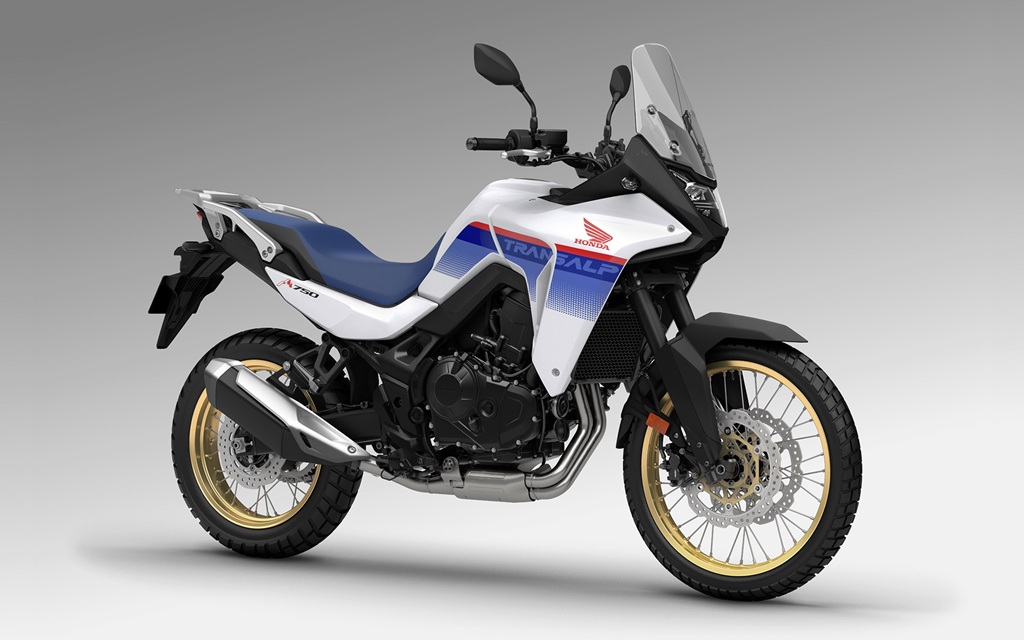
The trusty travel bike returns for 2024
Whenever the OEMs introduce a new engine, the first reaction from the slobbering adventure bike-riding masses is to say: “I wonder what that would look like in an ADV chassis.” For once, an OEM listened to their pleas right from the start and when Honda introduced the CB750 Hornet, it followed with the Transalp almost immediately after, powered by the same engine.
The oddness continued, with the street-oriented CB750 Hornet not available in Canada yet for 2024, but the Transalp is very much here, and this winter, I had a chance to ride it from Los Angeles to Las Vegas, mostly through the desert. Before the trip, I wasn’t sure what to expect from the Transalp. When I got home, I knew exactly what the bike was—it’s a smart, well-designed adventure travel that has everything you need, as long as you don’t need raw aggression.
This theme starts with the engine. The 755cc liquid-cooled parallel twin engine, with 270-degree crank and SOHC/four-valves-per-head design, is more on the mild side than the wild side. Depending who you ask, it makes 90 hp at 9,500 rpm in its European spec, or 83 hp at 8,500 rpm in its US spec (which is the one I rode). Which engine does Canada get? I’m not sure, but I can say that the American bike I rode had sufficient power, and more—but it certainly wasn’t a hard-edged machine.
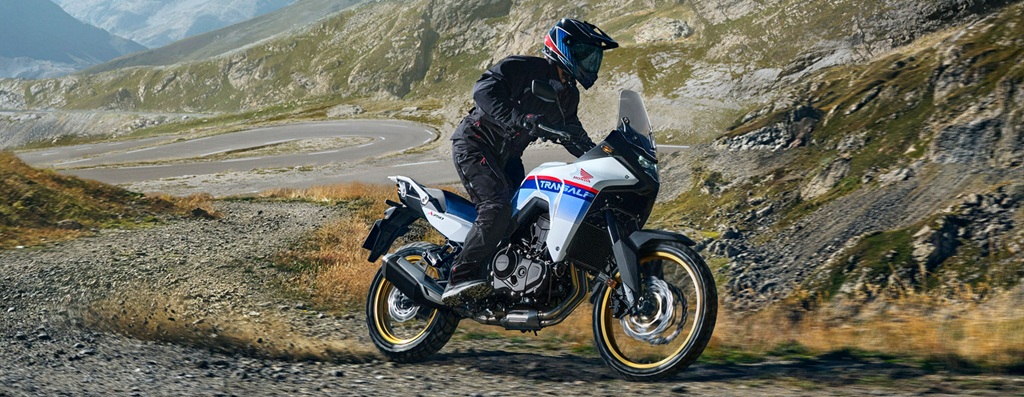
The exhaust note actually sounded muscular, but not untamed. That’s the experience when you’re underway; the engine builds its power in a linear diagonal line all the way to the top of the rpm range, while the torque curve is relatively flat with a peak about mid-way through the rpm. You have all the grunt you need, but the bike doesn’t loudly advertise it, or eagerly flex its biceps.
That means you get a nice, non-rattly engine that pumps out power mile after mile after mile. The vibration was so low that I often ran in fifth gear instead of sixth to get more quick roll-on power.
Of course I could have lugged it in sixth and gotten to fifth with a boot at the quickshifter, but the quickshifter was less smooth at low rpm, and I actually preferred the easy assist-clutch for sliding through the gears. The quickshifter is standard equipment, but if the Transalp didn’t come with it, I don’t think I’d pay extra for it. Gear-shifting is a smooth and easy task.
At legal highway speeds, the bike got about 40 mpg, and probably could have done better if I wasn’t battling a headwind. Fuel economy dropped badly when I was cruising the interstate at high speed, but eventually the winds dropped and so did my speed as I turned down back roads. I think a careful rider could get near to 400 kilometres out of the bike’s tank.
With all this added up, you can see the Transalp fits in nicely between the NX500 and CRF110L Africa Twin as a middleweight, sensible and easy-to-ride bike with an emphasis on rideability over sporting attitude. Speaking of which, the bike does come with a Sport riding mode, as well as Rain, Gravel, Standard and User-defined. I left it in Sport almost the whole time I rode, except for when it rained on Las Vegas’ slick streets, and I used… Rain mode.
I also managed to get in a short stint of gravel road riding on the Transalp. Loaded down with hard luggage, and on street-oriented tires, I wasn’t going to push my luck or the bike very hard. The Transalp handled it all very nimbly, but I did feel that Gravel mode’s traction control was too sensitive and that the rear shock would need some tweaking if I’d wanted to ride at a fast clip. However, the luggage certainly wasn’t helping things and I could have turned the traction control (and ABS) off entirely, had I wanted to spend more time tinkering with things instead of riding.
So the bike is more of a road-oriented travel machine than an off-road trailblazer—no big deal, that was the case with the first-generation Transalps too, and they were plenty popular in the European market! The new Transalp is so pleasant to ride on the street, which is where most people are usually riding their ADVs, that the current-generation machine will prove popular in Canada, I think. Not everyone is looking to blast through Baja off-road.
The seat is extremely comfortable—I rode four days, after two months out of the saddle, with no pain—and it’s a very manageable 855mm high. Walking up to the bike, you don’t feel you’ll need a stepladder to climb up.
Once you’re aboard, you get an easy-to-navigate switchgear on the left-hand handlebar. The buttons are clustered a bit differently than I’d prefer, with a massive hazard light switch next to the indicators—you can see how a problem would arise, if you’re stabbing blindly with your thumb. But overall, I found the Transalp’s electronics were easy to switch; I especially liked the quick-switching ride modes. The ride modes control the level of interference from traction control and antilock brake systems, but the settings for those can also be adjusted or turned off once you figure the electronics suite out.
Speaking of TC and ABS: Those systems are old-school designs that don’t use an inertial measurement unit (IMU). That means they aren’t leaning-sensitive, but they’re still very useful.
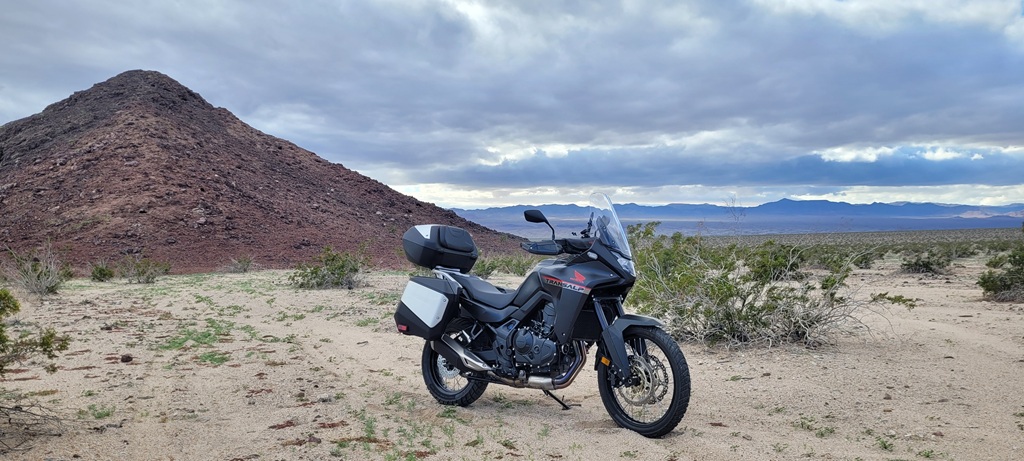
The bike I rode came with handguards and an added aerodynamic package, which cut windblast to a minimum when combined with the tall screen. I’m not sure how good the standard model is, but I rode for four days in heavy gusts and I felt almost as comfortable as if I’d been on a Gold Wing. Add in the easy-to-use, easy-to-remove plastic sidecases and top box, and I think a lot of touring riders are going to look at this bike much more seriously than they will a heavy and more-expensive Wing in the years to come.
Of course, the Gold Wing has always had a big engine and handling that belied its weight while the Transalp is a middleweight (and not a powerful one, at that) with a 21-inch front wheel that slows its steering in the corners (handling was very good, I felt, but like all ADV/dual sport models, you had to work a bit harder at it).
If you don’t like the suspension, there’s not a lot you can do about that, either; the inverted Showa SFF-CA fork is non-adjustable, and the Showa shock is only preload-adjustable (200 mm and 190 mm travel respectively).
But I think Honda made an effort to sell to the consumer who isn’t really concerned about max speed and dialing in finicky suspension tweaks—think “KLR Owner, Who’s Moved On Past The Milk Crate To Finer Things.” There are a lot of touring riders who just want to explore at a slightly extra-legal pace on a comfortable bike, and with its soft long-travel suspension, easy-handling 208 kg wet weight and competent motor, that’s exactly what this bike delivers.
Asking price in Canada for 2024 is $12,599. That might sound like a lot, until you consider the Yamaha Tenere 700 is $13,599 for the base model, with less power (but probably more off-road capability). The Kawasaki KLR650 is a lot cheaper at $8,299 for the ABS-equipped standard model, but it has less than half the horsepower and actually weighs more at the curb, if you believe Kawi and Honda’s respective spec sheets. The KTM 790 Adventure is about 5 kg lighter, and holds that weight much better, low down in the chassis—and it also makes more power, revving more aggressively to around 95 hp maximum. But the 790 Adventure MSRP is around $13,900 in Canada for 2024, and KTM only managed to keep the price that low by manufacturing the bike in China, which will be a turn-off for some riders. The quickshifter also doesn’t come as standard on that bike, although it does come with IMU-powered safety electronics.
So, I think the Transalp is going to sell well because it’s an enjoyable bike to ride, at an attractive price point. It’s not rocket science, but it’s a formula that always works, especially coming from a company with a reputation for build quality. Let’s hope Honda’s winning ideas spread across the industry; everyone, especially the OEMs, would benefit.