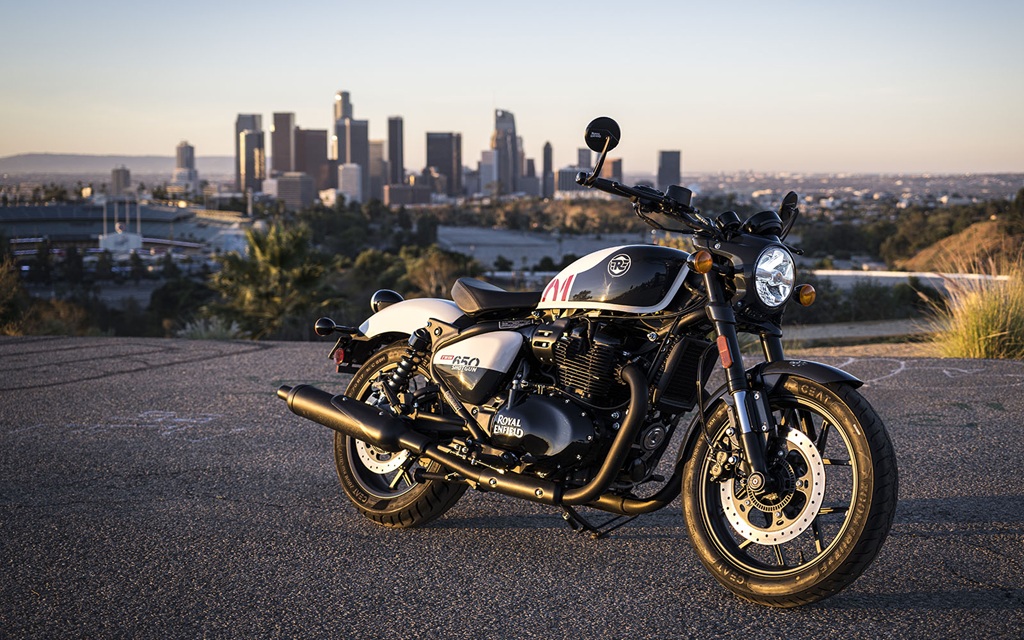
Last December, Royal Enfield invited the cream of the international motorcycle press to the launch of the Shotgun 650. I had the distinguished privilege of discovering this new model in Los Angeles, capital of the American custom scene, and in the surrounding canyons. It was a pleasant surprise, and one of the best launches I’ve participated in over the last few years.
It’s a cruiser! It’s a bobber! It’s a roadster! It’s a neo-sport! No, it’s a Shotgun 650! In fact, Royal Enfield’s new twin-cylinder machine combines a bit of all of these, and more.
Customization on the menu
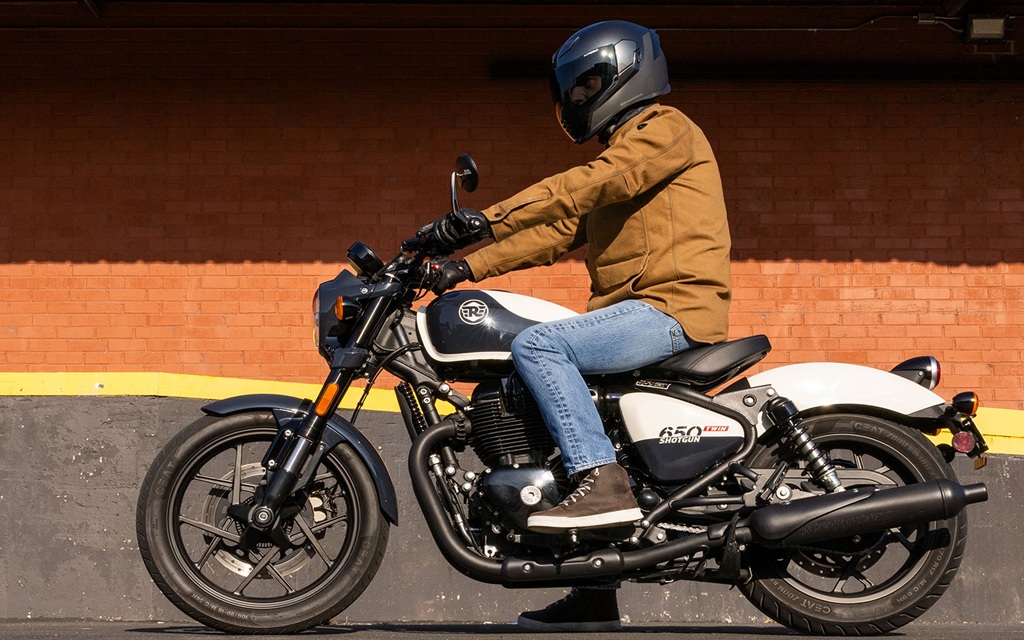
The Shotgun 650 is a minimalist motorcycle designed to be customized to the owner’s taste and adapt to his preferred riding style, depending on his mood of the moment. This is evidenced by the ingenious removable subframe that can host the passenger seat or a luggage rack. Taking the passenger seat out (by simply turning a key), and removing the rear loop (just unscrewing four bolts) transforms the Shotgun into a single-seater motorcycle in the blink of an eye. This is both a practical and versatile characteristic, as well as a distinctive design element.
Typically, the design of a motorcycle follows a linear pattern: research leads to development, which in turn leads to the testing phase, and then to production. But not in the case of the Shotgun, which is the result of a fortunate incident. A moment of grace. Royal Enfield’s history epitomizes customization. And the Shotgun stems from all the customizations that owners of the Indian brand’s motorcycles have made to their machines, which inspired the designers. Especially since the release of the twin-cylinder INT650 and Continental GT models, and more recently of the Super Meteor 650, which I had the chance to try out in Texas last October. Royal Enfield drew inspiration from these numerous customizations to create the SG650 prototype unveiled at EICMA in 2021. This concept bike received unanimous praise, prompting the company to put the Shotgun 650 into production in a version very close to the prototype. The result is a motorcycle with multiple styles and personalities. That makes it difficult to position in the market, as the Shotgun’s profile can change rapidly depending on the environment, the mood of its rider and the accessories he adds on.
During the first day of this launch, we had the opportunity to discover in the flesh several of the personalized Royal Enfield motorcycles that inspired the designers of the SG650, as well as a selection of Shotgun 650s customized by some of the greatest builders on the planet. This exhibition took place at the Bike Shed in Los Angeles, a prominent venue in California’s custom culture scene.
A well-known basis
The Shotgun 650 is based on the platform of the Super Meteor 650; they share the same engine, frame, gearbox, and brakes. Indeed, the Shotgun is propelled by the cruiser’s 648 cc SOHC parallel twin-cylinder engine with two valves per cylinder, air- and oil-cooling and a counterbalanced crankshaft with a 270-degree firing interval. Its performance figures are similar to those of the other 650s in the brand’s lineup: a claimed power output of 46.4 hp at 7,250 rpm and a maximum torque of 38.6 lb-ft at 5,650 rpm. This engine is mated to an efficient and precise six-speed gearbox.
Otherwise, the Shotgun benefits from a revised suspension, a new bodywork, but most notably, a more playful steering geometry (sportier rake/trail of 25.3 °/101.4 mm and a shorter wheelbase of 1,465 mm).
The single seat seems to be floating behind the 13.8 L fuel tank (1.9 L less than that of the Super Meteor). It overhangs the cruiser-style rear fender, giving the Shotgun an unmistakable look.
The steel tube frame, although similar to that of the Super Meteor, features a sportier suspension incorporating Showa components. Up front, there’s a sturdy non-adjustable 43 mm inverted BPF (Big Piston Fork); at the rear, a pair of preload-adjustable shocks is in charge of absorbing road bumps and potholes.
The Shotgun’s front end is 33 mm lower, and the bike is more tilted forward. The rear is raised by 20 mm, and the suspensions offer 90 mm of travel.
Another major difference is the wheel sizes: the Shotgun features an 18-inch front wheel and a 17-inch rear wheel, shod with Indian CEAT Zoom Cruz tubeless tires, instead of the 19 and 16-inch combination of the Super Meteor. This drastically changes its behaviour.
As for the riding position, it is more neutral than that of the Super Meteor, partly thanks to the central positioning of the footpegs, which align with the shoulders and hips. Seat height is 795 mm, 55 mm more than on the Super Meteor.
The braking system is identical to that of the Super Meteor. The single 320 mm front disc is gripped by a two-piston ByBre caliper, and the huge 300 mm rear disc is bitten by an identical ByBre caliper. The system is complemented by stainless steel braided lines and a dual-channel ABS as standard.
The instrumentation includes a digital-analog instrument cluster and a Tripper navigation system. On the Shotgun, it is linked to Royal Enfield’s brand new Wingman app, which keeps the rider informed of the bike’s real-time location, fuel and engine oil levels, maintenance reminders, and much more. Lighting is taken care of by a large round LED headlight housed in a superbly moulded aluminum nacelle that frames the gauges. The handlebar switchgear is also moulded, ensuring the quality and robustness of these parts, as well as superb aesthetics. A USB port is also installed for charging your devices.
Finally, since style must certainly be discussed on a machine intended for customization, my opinion is that this is an elegant and quite finely designed motorcycle. The lines are harmonious, blending the past and the future into a coherent whole. The colours are sober and underline the heritage of the brand without any error of taste.
Riding impressions
Our initial encounter with the Shotgun 650 begins in the congested streets of Los Angeles, specifically in an industrial area near our hotel that is frequently used for photo sessions and film shoots. All of this is supervised by the LAPD Entertainment Trademark Unit (ETU), which blocks traffic for us.
In the dense urban environment of the City of Angels, where traffic is particularly heavy, the Royal Enfield shows surprising ease, weaving through vehicles with finesse. The bike is user-friendly and it can easily be maneuvered with light touches. It offers a good turning radius and changes direction with a simple push on the wide tubular handlebar. The engine pulls crisply and without hesitation at low revs, and its solid torque allows you to escape traffic with a simple twist of the throttle. No drama or fear involved. Also aided by a gearing that favours acceleration, combined with a smooth transmission, the Shotgun allows seamless gear changes, especially since throttle response is surprisingly smooth and precise and absolutely sputter free. Combine this smooth character with flawless fuel delivery, and you have an ideal city bike. Additionally, the cable-actuated clutch is remarkably light.
The engine pulls well at low revs without any hiccups, even though it’s hard to tell the exact rpm due to the lack of a tachometer. The gears are well spaced, providing strong acceleration without requiring too frequent shifts. With its 270-degree crankshaft, the twin-cylinder has a lot of character and is very pleasant to use, especially in heavy traffic.
Thanks to its reasonable seat height, the Royal Enfield facilitates our urban maneuvers. Standing at 1.77 m, I can easily plant my feet on the ground at stops. Moreover, the bike’s weight – 240 kg – is not really noticeable while in motion. Additionally, the riding position is neutral; the back is straight, arms and legs are slightly bent.
Once our urban photo session is over, we take the freeways to leave the sprawling city and head towards the canyons north of Los Angeles. On our way, I have the chance to indulge in one of my favourite motorcycle practices: lane splitting. Since it is legal in California, I seize the opportunity and enjoy it immensely, especially because motorists make it easy by cooperating in good faith. Paco, Royal Enfield’s lead rider, is experienced in lane splitting and he maintains a good pace between the rows of cars. He is followed by the legendary English journalist Alan Cathcart, who is still pretty quick despite his 78 years of age, and Freddie Spencer, whom I trail closely. A dozen journalists with more or less experience with this practice follow us, forming a line several hundred metres long.
When traffic clears, allowing us to speed up, the Shotgun cruises comfortably at about 120-130 km/h. At this speed on the highway, the sixth gear seems overdriven, and I sometimes feel the need to downshift to fifth. The vibrations are relatively well-contained under these circumstances. The engine is not a powerhouse and won’t tear your arms off, but power delivery is pretty linear and always available. The twin has good mid-range oomph and it is helped by a smooth and precise six-speed gearbox with a light-pull clutch.
At highway speeds, the wind protection offered by the Shotgun is minimal, as with any naked bike, but you can ride at a relatively high pace before feeling the wind pressure turning you into a human parachute. The firm seat provides decent comfort, though you might wish for the ability to change position while riding.
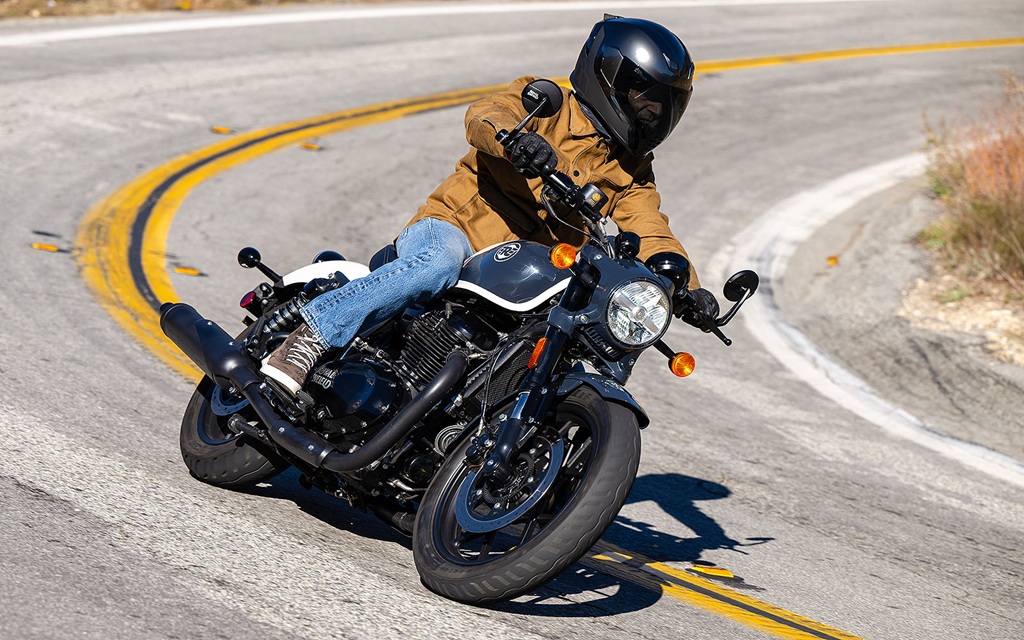
Half an hour later, we leave the freeways and enter the winding mountain roads of the Angeles National Forest, located about 50 kilometres north of the Californian metropolis. The scenery changes suddenly, and so does the road. It climbs and twists in endless curves. The road we take through the forest (Road 2) is narrow, delightfully winding, and somewhat bumpy, putting the suspension to the test: it performs quite well under the circumstances. The non-adjustable fork, which is relatively soft initially, stiffens over bumps and potholes but never bottoms out or dives excessively under heavy braking. Better still, it doesn’t unsettle the bike, which remains well-planted, and it delivers full road grip control. The front CEAT Zoom Cruz 100/90-18 tire offers reassuring road feel and good feedback. The rear shock absorbers lift the back of the 650 even though they offer 20 mm less travel compared to those on the Super Meteor. These classic shock absorbers, adjustable for spring preload only, are effective in city driving, especially for absorbing potholes and changing surfaces, but they show their limits on fast, winding roads. In fact, it’s the lack of ground clearance that hampers the Shotgun on this road. When the pace quickens, you quickly scrape the footpegs in turns, even if your lean angle is not radical. Otherwise, the bike remains very stable in corners, even at high speeds, as we will see on our way back to Los Angeles.
In the last section of Road 2 through the forest, the temperature drops a few degrees, and the wind picks up. It starts to feel slightly chilly, even though the sun is still shining. That’s because we’ve climbed to nearly 2,000 metres in altitude. Fortunately, we arrive at the Vincent Hill Station restaurant, where we can warm up and refuel.
After a well-deserved lunch break, we head back to the hotel via the magnificent Angeles Crest Highway, a beautiful two-lane road (one in each direction) that crosses the San Gabriel Mountains north of Los Angeles County and the Angeles National Forest. Some sections reach altitudes of over 2,100 metres, with a peak of 2,409 metres at Dawson Saddle, making it one of the highest roads in Southern California. About a hundred kilometres long, the road connects with the town of La Cañada Flintridge, to the west, at the border between the Los Angeles and San Bernardino counties. The last section is named the Angeles Crest Scenic Byway and it’s breathtaking, especially for motorcyclists. It’s made of long, fast descents where you can push the bike to its limits. In this section, I am part of a small group with four other riders: Paco, Alan Cathcart, Freddie Spencer, and Mark Wells, Royal Enfield’s chief designer. In this environment, we adopt a very brisk pace. Testosterone is in the air! The footpegs scrape excessively. The front tires of our Shotguns squeal under the strain. One finger on the clutch, two on the front brake, I watch my fellow riders very attentively. At times, atop a crest, we ride into a wall of light. The setting sun to the west blinds us with its nearly horizontal rays. I can barely see the taillights of the bikes ahead of me. No sudden braking to avoid unsettling the bike at maximum lean, and most importantly to avoid hitting the riders in front of me. It’s been a long time since I’ve ridden this fast on such an exciting road. It’s nirvana! Especially since I have complete confidence in my fellow riders. They are all exceptional pilots. The rest of the group is far behind, riding at their own pace.
On this road, in these particular conditions, the Royal Enfield is amazing and reassuring. It impresses me in high-speed curves, remaining stable and responsive. It’s certainly not a supersport, but it’s clearly not a deadweight either, and it handles surprisingly well. Well enough for me to forget that I’m riding a bobber from India, indeed. It’s quite an impressive machine to ride in the canyons!
The braking system, with its two large-diameter single discs – 320 mm at the front and 300 mm at the rear – is very effective. Particularly the rear brake, which slows the bike in a perfect manner. Personally, I used it to steer the Shotgun in corners. The standard dual-channel Bosch ABS works well, without significant intervention, even during sudden braking.
After an hour of this addictive ride, we reach the northern neighbourhoods of the metropolis. We take the highway, weaving through lines of cars to get back to the hotel in a final 20-minute sprint through dense traffic, both on the highway and in the city. A few quick starts at traffic lights reveal the pep of the Royal Enfield. Between traffic lights, I stay in second or third gear, using the twin-cylinder’s torque to break free from the flow of cars.
During this 250 km journey, we discovered all the faces of the Shotgun: cruiser, bobber, roadster, and sportbike. This is a playful and efficient motorcycle that’s never boring. Its performance is more than decent and it allows for fun in all circumstances. Its weight was never a handicap, nor were its minimally adjustable suspensions. As for the absence of a tachometer, it didn’t bother me much. You just have to play it by ear and listen to the song of the engine.
Considering its qualities and its price (expected to be in the range of the Super Meteor – $9,599 to $9,999 depending on the model), the Shotgun is a great deal.
As for criticisms, let’s note the limited ground clearance, slightly firm suspensions, and low-contrast instrument display that’s hard to read at high speeds or in sunlight. Plus a 20 kg overweight issue, but that never turned out to be problematic or redhibitory. Besides that, I give it my stamp of approval!
A pleasant surprise
At its launch, the Shotgun 650 truly surprised me, offering more than I had expected. Despite its bobber look, it’s a no-nonsense bike that focuses on the essential, namely delivering simple pleasures. With no electronics, except for ABS and fuel injection, it’s playful, easy to live with on a daily basis, and comfortable on all types of roads. This is a performance-oriented standard bike that behaves like a sporty roadster on secondary roads. It’s enjoyable to ride whether in the city, at low speeds, or on winding mountain roads at a spirited pace, bringing a broad smile to your face every time you take it out. Unlike the Super Meteor 650, which I tested last October, this is a bike I could live with on a daily basis. It’s not an American-style cruiser but rather a neo-sportbike with an urban inspiration. What’s more, it’s easily customizable and can change its look and mood according to yours.
The Shotgun 650 offers an interesting option for anyone looking for a simple, old-school motorcycle with modern technology. Personally, along with the INT650, it is one of my favourite Royal Enfields. I love the brand’s twin-cylinder models, but I find the Continental GT too radical for my needs and the Super Meteor’s custom style is too much for me.
The Shotgun 650 is a fine machine and it proved perfect in the environment where we discovered it, showcasing all its dynamic qualities. Let’s hope it finds its audience because it deserves it.
The Royal Enfield Shotgun 650 is available in four unique colours: Sheet Metal Gray, Forest Green, Plasma Blue, and Black/White for the upscale version.
For more information on Royal Enfield and the Shotgun 650, click here.
SPECIFICATIONS
GENERAL DATA
Curb Weight: 240 kg
Seat Height: 795 mm
Fuel Capacity: 13.8 L
Fuel Consumption: 4.7 L/100 km
Fuel range: 295 km
Test duration: 275 km
Colours: Sheet Metal Gray, Forest Green, Plasma Blue, Black/White
Price: TBA
ENGINE
Engine type: parallel twin, four-stroke, Euro 5, SOHC, 2 valves, air/oil-cooled
Maximum power: 47 hp at 7,250 rpm
Maximum torque: 38.6 lb-ft at 5,650 rpm
Displacement: 648 cc
Bore x Stroke: 78 x 67.8 mm
Compression ratio: 9.5:1
Carburation: electronic fuel injection
Transmission: 6-speed
Final drive: chain
CHASSIS
Frame: tubular steel with central backbone
Suspension: 43 mm non-adjustable inverted BPF fork, 120 mm travel; twin shock absorbers, adjustable for preload, 90 mm travel
Wheelbase: 1,465 mm
Rake/Trail: 25.3° / 101.4 mm
Brakes: single 320 mm front disc with ByBre 2-piston caliper; single 300 mm rear disc with 2-piston caliper; dual-channel ABS standard
Tires: CEAT Zoom Cruz 100/90-18 front; 150/70-17 rear
QUICK VERDICT
WE LIKED:
The overall look
The build quality
Enjoyable engine performance
Rewarding exhaust sound
Easy to get accustomed to
Great performance/price value
WE LIKED LESS
The heavy weight
Slightly firm suspension
Lack of cruise control
Improvable ground clearance