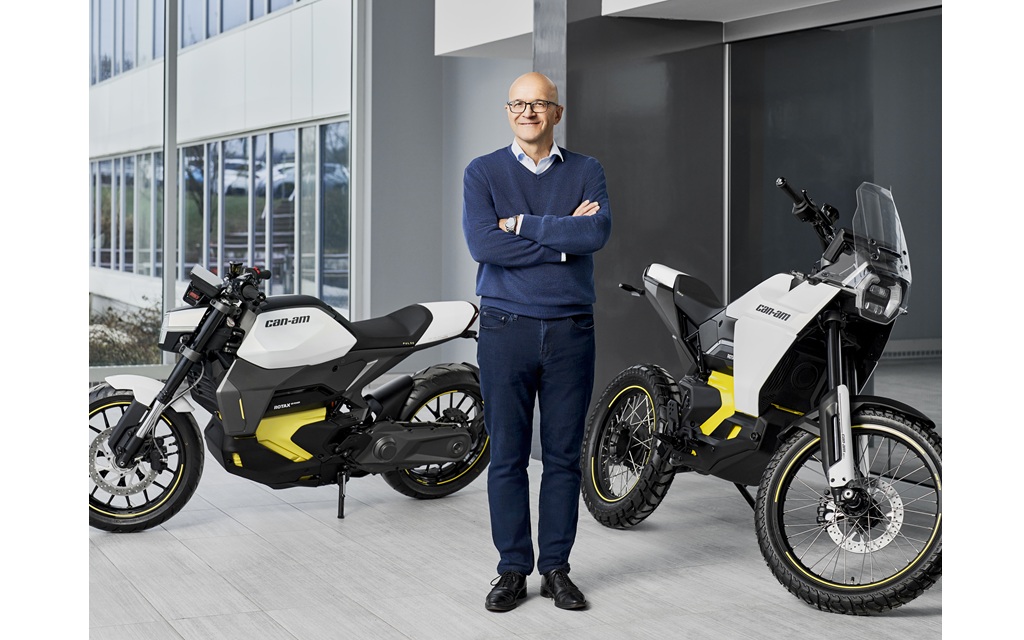
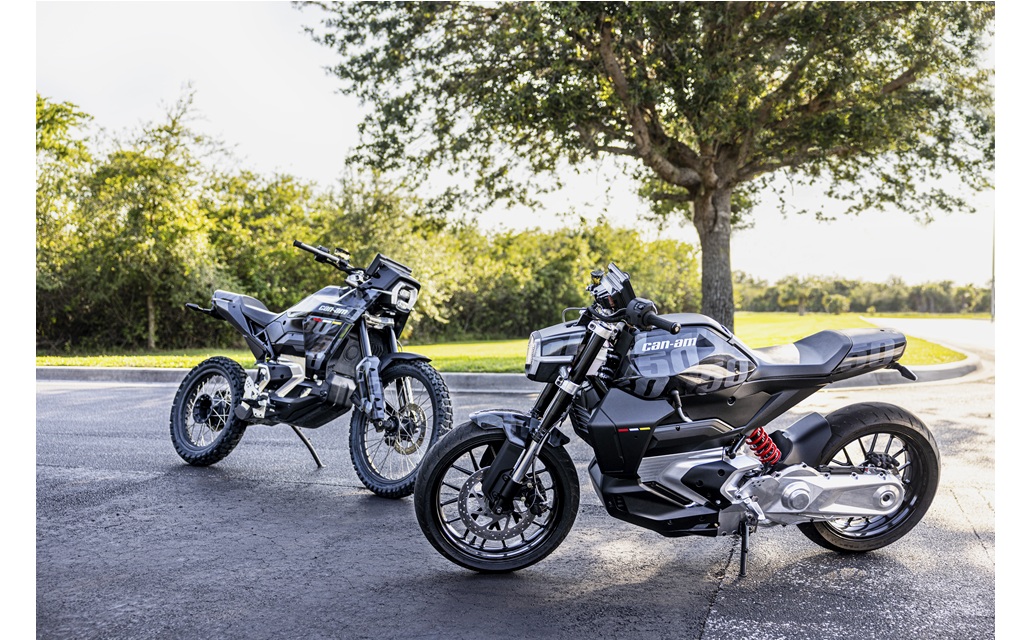
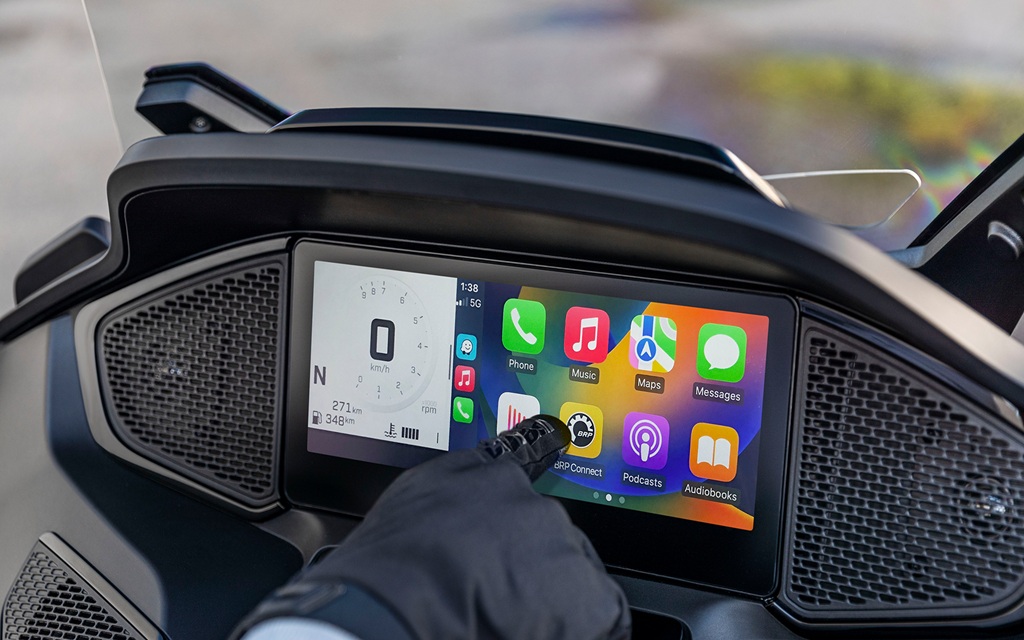
Today, on the road, Can-Am is primarily known for its unique 3-wheeled machines, but the power sports brand recently captured the attention of the motorcycling world by announcing its return to two wheels with a range of electric motorcycles. While awaiting their market release, Can-Am unveiled some 2024 news. For Ryker models, changes are mostly cosmetic, while Spyder F3s receive a new distinctive LED headlight. The biggest news, however, is the adoption by all Spyders of an all-new instrumentation using a 10.25-inch screen and featuring Apple CarPlay technology as standard equipment. The new instrumentation also offers connectivity functions allowing it to be connected to a communications-capable helmet. Following these announcements, the CEO of the Quebec-based manufacturer, José Boisjoli, made himself available for a few questions.
BG : The year 2023 marked the 15th anniversary of the Spyder, but the event wasn’t really underlined. Furthermore, the amount of 2024 news regarding the Spyder and Ryker lineups isn’t particularly high. Could it be some sort of voluntary restraint intended not to interfere with the much-promoted 50th anniversary of the Can-Am brand and its return to the world of two wheels?
JB : I would argue that the new instrumentation installed on all our Spyders is actually quite significant news. In the automotive world, Apple CarPlay technology is basically everywhere and it was one of the most requested improvements asked by our customers. Now, users can connect their cell phones to their vehicle, to their helmet and even to their friends’ helmet. The information is displayed on a big screen and using dedicated buttons on the left-hand control, riders can manage their calls, their music and even communications with their riding companions. It’s a very well-integrated system that I think will be very much appreciated by users. We introduced this technology last year in our snowmobile division with our Advex helmet and Vibe communications system. I’m personally a user and I push the adoption of the tech over at Can-Am. We’re only at the beginning of its integration on our vehicles. So, sure, some years are bigger than others when it comes to product launches, but I’m confident our customers will greatly appreciate these improvements, especially Apple CarPlay as it was one of the most asked for features.
Regarding the Spyder’s anniversary. We pioneered the industry 15 years ago. It had never been done before, such vehicles with two wheels in the front and one at the back. A motorcycle brand offers products with two rear wheels and one front wheel, and a competitor has launched a model you sit in with two front wheels and one rear, but we still hold 60% of the three-wheel vehicle market. Moreover, what pleases me a lot is that the Ryker has brought in a lot of new users who, after a few years, move up to F3s or RTs, which is very interesting. We are very pleased with the evolution of the Spyder, even though we’d like the extraordinary per capita penetration of Quebec to also manifest elsewhere. We finished number one in sales in Quebec, including motorcycles, which is incredible. One of my greatest prides is that these are products invented and designed here, and also built here in the case of the F3 and RT. When I’m out on the road, I often see more three-wheelers than two-wheelers, so our case is truly special. Perseverance is key. We’re seeing more and more of them in the United States, and there are associations there that are fanatical about three-wheelers, so for us, it’s good business, and we need to continue working to make it grow.
BG: On this subject, are you able to explain why no one has yet decided to directly compete with your Spyder? We occasionally see prototypes and patents being filed for three-wheel concepts, but until today, no direct competition has emerged. It’s difficult to understand.
JB: I’ll answer as our Chief Design Officer Denys Lapointe would: It seems that companies that are good at making a product are often bad at reinventing or changing their own paradigm. According to this logic, motorcycle manufacturers may not be very good at changing the paradigm of their industry. We weren’t in the realm of two-wheelers, so we developed a different type of prototype, and that’s how we ended up launching a three-wheeler. The market is still growing, but it’s not yet as big as the two-wheeler market, which is evolving well, in Europe more than in America, actually. I think sooner or later people will catch on, but it’s a matter of focus, paradigm, changing the rules of the industry… Denys Lapointe would tell you that an expert in a field is the worst at changing the rules of his own industry.
BG: The case of the Ryker is interesting. Could you tell us a bit more about it? It’s an entry-level product that seems to convince its users to upgrade to higher-end products. Is this indeed the case, and has it therefore achieved its goal?
JB: What’s unique about the Ryker is that it is an affordable entry-level model, but it’s also easy to operate thanks to its automatic (CVT) transmission. It’s also very interesting to note that we have a lot of customers who are brand new and have never ridden a motorcycle before. We also have a large female clientele who buy a Ryker and then upgrade to an F3 or an RT. What I’m very proud of is that compared to motorcycles where about 15% of the clientele is female, with us, it’s 34% of Spyder and Ryker owners who are women. Another interesting statistic is that in three-wheel riding courses in Quebec, 50% are women, so sooner or later, we will reach parity. I am convinced that there is a market there and that it will expand worldwide.
BG: Let’s move on to motorcycles. At the moment, Can-Am hasn’t provided any data regarding power, battery, or range of future models, and I don’t believe you’ll be willing to disclose them now… unless I’m mistaken?
JB: You’re not mistaken.
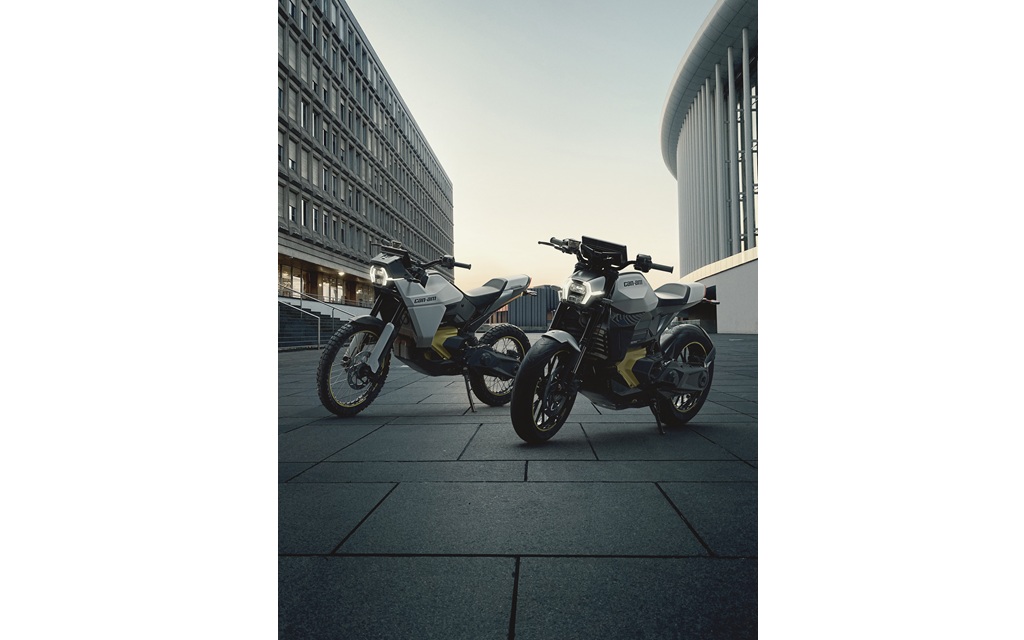
BG: Alright, let’s approach the subject differently then. Even though BRP offers a wide range of products, in the eyes of the average motorcyclist, Can-Am is currently the brand transitioning from three wheels to two wheels. Could you explain what the most challenging part of launching this new venture has been?
JB: Let me start from the beginning. In the automotive industry, which is leading the world towards electrification, there are very clear rules. Canada, Europe, and other markets have defined that starting from a certain year, everything must be electric, and for this reason, manufacturers will transition very quickly. What’s fascinating in our industry is that there are no rules, at least not yet. Take the example of mountain snowmobiles. In my opinion, this is a case where a natural transition to electric will take some time. Every year, when we ask our customers about their interest in buying an electric side-by-side or snowmobile, 90% confirm that there is interest. But when we tell them that the range will be reduced by 50%, that the price will be 25% higher and that the weight will increase by 25%, interest drops from 90% to 15%. But it’s still 15% of the existing customer base, so we can’t ignore that there is some demand. What’s fascinating and what I love is that there are no rules.
Now, just as we must invest in internal combustion engines to make them evolve, we must also do so with electric ones. When we started considering the electric project, we sent a team around the world for about a year to find the best technologies and the best partners. When we considered the approach of buying different components, like the motor and batteries here and the inverter and charger there, and paid everyone, there was no margin left, and the costs were high. What we ultimately decided is quite bold, as we chose to do the same thing as with the internal combustion engines that we produce ourselves. So we embarked on designing our own battery pack, our own electric motor, our own inverter, our own chargers, and even our own programming. All of this will be BRP technology. Over the past three years, we’ve hired 200 experts based in Valcourt and 100 based in Austria at Rotax, and these 300 people are working on developing the five technologies mentioned earlier. Currently in Valcourt, we have a prototype production line that assembles battery packs. We buy the cells, which look like AA batteries, and assemble the packs ourselves. In Austria, we are setting up the production line that will manufacture our own electric motors. All of this brings benefits. Because we decide what the design of our parts will be, we can maximize the use of available volumes in the vehicle. One of the biggest challenges of electric vehicles is the final balance between a series of factors. For example, the larger the range we aim for, the larger, more expensive, and heavier the battery pack will be. So we need to find the right combination and balance to meet the user’s needs.
A good example is our first electric snowmobile. It’s one of the most challenging electrified products to design because we immediately lose half of the range due to the cold and then have to deal with very high resistance during use. Taking all of this into account, we understand that creating a snowmobile with a 200 km range becomes impossible. So we turned to the kind of use that a tour operator in Finland has. They’re located next to our factory there and have a fleet of 700 or 800 units. They offer customers three rides of about 40 km, seven days a week. A group of customers sets out in the morning for about forty kilometers, then returns to the center, then another group leaves and returns, and finally a last one. We’ve defined with them that a range of about fifty kilometers is sufficient in winter, and we adapted the battery pack to deliver this range in cold temperatures, which gave us a reasonable cost and weight. As a manufacturer, we must define the needs of our customers and adapt our products to them, and our modular approach allows us to do so. Thus, in some products, we will have one battery pack, in others two, and in others three. If we had, instead, aimed for a range of 100 km for the snowmobile, then it would have been twice the battery, twice the price, twice the weight. The modular approach allows us to precisely adjust the balance between cost, range, and weight that corresponds to the determined need. And all of this brings us to our greatest challenge, which is the compact nature of our vehicles. It’s not like a car where the floor can be filled with batteries. On a motorcycle, space is very limited. That’s where the challenge lies: achieving a balance between the power of the battery pack and the restricted space to obtain the best possible range at a reasonable cost for customers.
BG: One last question. Up to now, very few electric products have been brought to market by major motorcycle manufacturers, and none of them has achieved great success. In short, a situation like that of the Tesla Model Y, which outsells an equivalent gasoline product, absolutely does not exist in the motorcycle industry. Do you really think you can break through this barrier?
JB : Here’s what I’d respond. As we established earlier, our data tells us that there is interest in electric motorcycles. It’s up to us to find the right balance between, once again, range, weight, and price, and I think we’re pretty good at that. Then, it’s a matter of visibility and presence. We’re coming in with the Can-Am brand and a dealership network established in around a hundred countries, in short, with firepower, I’ll put it that way, that few manufacturers have. We have internal goals, and we believe that we need to return to the world of two-wheelers. Bombardier left it in 1987, and our motivation in coming back is to become the Tesla of motorcycles.